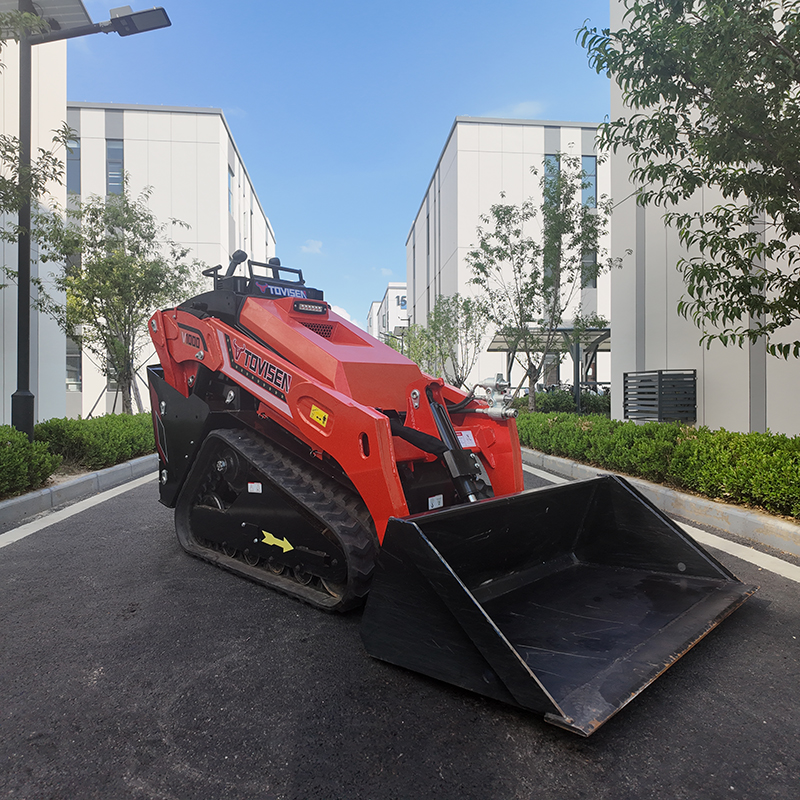
It reaches places larger loaders cannot.
Narrow models can pass through residential gates, work between buildings and operate on compact landscaping or farm sites.
New to mini skid steers? Learn the essentials in plain English, then answer practical questions about your jobs, access limits, ground conditions, attachments, budget and buying route. We rank machines using verified specifications, keep complete catalogue records visible for research, and compare established dealer-supported options alongside Chinese brands.
Follow the structured learning path in plain English, then use the matcher. New lessons cover emissions compliance, wear costs, used-machine inspection, resale and workplace safety. This section is optional and collapses when you are ready to compare machines.
Expanded lessons covering the full buying journey take you from “what is this machine?” to a complete brief you can use in the matcher. Use the lesson buttons or work through with Next.
A mini skid steer is a compact, self-propelled hydraulic tool carrier. You stand on a rear platform or walk behind it, steer by varying the tracks or wheels, and swap the front attachment to change jobs.
Narrow models can pass through residential gates, work between buildings and operate on compact landscaping or farm sites.
A bucket, forks, auger, trencher, grapple or mower can turn the same carrier into a different tool in minutes-when the mount and hydraulics truly match.
Instead of shovelling, wheelbarrowing and manually positioning materials, the operator can carry, place and clean up from one compact platform.
Width, machine mass, rated operating capacity, load centre, attachment weight, hydraulic cooling, ground and operator training all determine whether it is suitable.
The logo is one of the least important decisions. Width, safe working capacity, hydraulic output, attachment mount, local support and the weight of the complete transport package matter more.
Tracks usually give better traction and flotation on soft ground. Wheels are simpler, faster on firm surfaces and can cost less to maintain.
Plain English: match the undercarriage to where you actually turn.Rated operating capacity is a controlled safe-working figure. Marketplace listings often show maximum lift force instead; the numbers are not interchangeable.
Ask for tipping load, ROC method, load centre and fitted attachment.Horsepower moves the machine, but continuous auxiliary flow, pressure, cooling and case drain decide whether a trencher, mower or stump grinder works properly.
“High flow” needs a number in L/min at a stated pressure.A 1,040 mm body will not fit a 1,000 mm gate. Measure the tightest opening, then include the bucket, tracks, hoses and safe clearance.
The finder penalises any machine wider than your answer.Most attachments fall into two broad plate families: the compact CII pattern, often called Toro Dingo-style, and the larger Bobcat or skid-steer quick-attach pattern. They are not interchangeable.
Choose the same basic plate family, then verify the drawing, latch, pins and a physical lock-up because manufacturers can vary the geometry.Direct import can be cheaper, but you become the importer, pre-delivery inspector, parts planner and warranty coordinator. Dealer pricing pays for some of that risk.
Compare landed-and-ready cost, not the headline factory listing.Open any chapter when you want more depth. Together they cover the machine, the language sellers use, attachments, auxiliary hydraulics, safety, transport, maintenance and buying routes.
Carrier means the machine itself. Attachment means the bucket, forks, auger or powered tool fitted to the front. Operating mass is the working weight under the manufacturer’s stated conditions. ROC, or rated operating capacity, is a controlled load rating. It is not the same as tipping load, breakout force or a seller’s maximum-lift claim.
Load centre describes how far the load sits in front of the attachment. Hinge-pin height is the height of the bucket pivot at full lift. Dump height is the clearance under the bucket edge when dumping. Reach is how far forward the machine can place a load. Each term answers a different question, so never compare one with another.
The engine or electric motor powers hydraulic pumps. Separate hydraulic functions drive the tracks or wheels, raise the loader arms, tilt the attachment plate and power auxiliary implements. Travel controls vary the speed on each side to steer. Loader controls raise, lower, curl and dump.
Before operating, identify neutral, throttle, parking brake, operator-presence system, auxiliary control, float function, emergency lowering and the lift-arm support. Control layouts differ. Ask for a proper demonstration, read the manual and practise unloaded on a level, isolated area.
Auxiliary hydraulics, often shortened to aux hydraulics and sometimes heard as “ox hydraulics,” are the hydraulic oil supply and return connections at the front of the machine. The engine turns a pump, the pump moves pressurised oil through hoses and couplers, and that oil powers a motor or cylinder on the attachment.
Aux hydraulics run augers, trenchers, sweepers, stump grinders, mowers, mulchers, snow blowers, tillers and other powered tools. They also open and close cylinders on grapples, 4-in-1 buckets, log splitters and similar attachments. A plain bucket or pallet forks normally use the loader arms and tilt circuit rather than their own auxiliary connection.
Flow, measured in L/min or gpm, mainly affects how quickly a hydraulic motor can turn. Pressure, measured in bar or psi, contributes to torque or cylinder force. “Low flow” and “high flow” are relative terms, not universal numbers. A seller must state the actual continuous flow and pressure available at the front couplers.
Low or controlled flow suits cylinder movements and attachments that need gentle positioning, such as opening a grapple. Standard flow commonly powers augers and trenchers. High-flow circuits are useful for demanding continuous tools such as forestry mulchers, heavy brush cutters, snow blowers and some stump grinders. Some machines advertise only one full-flow auxiliary circuit and call it high flow. That does not prove it can safely run low-flow tools: ask whether the flow is adjustable, proportional or supported by a separate low-flow circuit.
A powered attachment may work for five minutes and still overheat during an hour of cutting. Continuous-duty suitability depends on the oil cooler, reservoir, pump, hose size and the amount of engine power available after traction and loader demands. Ask for hot continuous flow, not only a cold-idle or total-pump figure.
A case drain is a separate low-pressure hose that lets internal leakage oil return safely from some hydraulic motors. Excess return back-pressure can damage seals. The pressure and return couplers must also match the attachment’s direction, size and fitting standard. Never plug an unknown tool in only because the connectors appear to fit.
Many modern mini skid steers have two separate auxiliary hydraulic circuits at the front:
The two circuits usually have their own sets of couplers (sometimes one pair on each side of the loader arms, or clearly labelled high/low). Using the high-flow circuit for a low-flow tool can make the attachment violent or overspeed the motor; using the low-flow circuit for a high-demand tool will make it weak and overheat the oil.
Always ask the manufacturer or dealer which circuit is which, whether the low-flow is proportional or only momentary, and which coupler pair to use for each attachment.
The two main plate families in this guide are compact CII / Toro Dingo-style and Bobcat / skid-steer quick attach. They are not interchangeable. Even within a family, latch geometry, pin spacing and hose routing can vary, so compare dimensioned drawings and physically test the lock-up.
A proper match includes plate, attachment weight, hydraulic flow, pressure, case drain, couplers, hose length, return limit, cooling capacity and written carrier approval. An adapter plate adds weight and moves the load farther forward, reducing effective lift and stability.
Capacity changes with attachment weight, load centre, boom height, reach, slope, travel direction and counterweights. A machine that lifts an object once may not be safe to carry it. Use a verified ROC and the exact fitted attachment.
Keep loads low while travelling, turn gently and avoid side slopes. Never stand beneath raised arms, allow riders or use a bucket or forks as a personnel platform. Follow the manufacturer’s load chart, operating-angle limits and training requirements.
Tracks generally spread weight over a larger area and improve traction on soft or uneven ground. Wheels may be simpler, faster and cheaper to maintain on firm surfaces. Both steer by skidding, so both can tear turf, disturb gravel or mark finished floors when turning sharply.
Ground pressure is useful only when calculated for the actual machine and track configuration. Mud, hidden voids, edges, trenches, retaining walls and slopes can remove support from one side very quickly. A questionnaire cannot approve a slope or replace a site assessment.
Transport starts with the complete ready-to-travel package, not the brochure machine weight. Add the bucket, fuel, operator platform, counterweights, spare attachments, mud, chains, ramps and any toolboxes. Then add the trailer’s own tare mass and compare the total with trailer payload, tow-vehicle limits, coupling rating, axle limits and local licence or brake rules.
Check the machine’s widest and highest transport configuration and its centre of gravity. One attachment may push the combination over a legal mass or create poor weight distribution even when the machine alone appears suitable. Obtain actual scale weights whenever possible.
Use a level, firm loading area and ramps rated for the machine, long enough to control the break-over angle and secured so they cannot separate. Keep people clear, travel slowly and follow the manufacturer’s specified travel direction. Raised attachments and sudden steering make a ramp more hazardous.
Lower the attachment, shut down, apply the parking brake and use rated chains or straps at the manufacturer’s tie-down points. Restrain loose attachments separately. Recheck tension after the first part of the journey and follow the transport rules for the country and vehicle combination.
Before work, walk around the machine. Look for oil, fuel or coolant leaks; damaged hoses; loose fittings; track or tyre damage; missing fasteners; cracked welds; worn pins; blocked cooling screens and anything caught around rollers or moving parts. Test the parking brake, operator-presence system and attachment latch.
Check fluid levels using the manual and correct fluid specification. Grease the listed points, keep couplers clean and inspect the attachment before connection. Small compact machines work in dust and debris, so a blocked cooling pack or loose hose can quickly become an expensive failure.
Service intervals can include engine oil, fuel and air filters, hydraulic filters, hydraulic oil, coolant, track tension, drive chains, belts, pins and bushings. The hour meter and calendar both matter. Record every service and never mix hydraulic fluids without confirmation.
Before buying, obtain the operator, service and parts manuals plus part numbers for filters, seals, hoses, couplers, tracks, rollers, sprockets, pumps, motors and valves. Direct-import buyers should hold sensible first-service and downtime spares. A cheap machine that waits months for a basic part is not cheap in commercial use.
Petrol can suit occasional work and lower purchase budgets. Diesel is common for longer commercial duty and low-speed torque. Electric can reduce local exhaust and noise for indoor or sensitive sites, but battery capacity, loaded runtime, charging supply, battery warranty and replacement cost must be known.
Fuel type does not prove quality or duty rating. Check engine identity, cooling, emissions acceptance, local service and the exact regional configuration. Indoor work still requires a plan for ventilation, dust, battery charging and pedestrian separation.
A dealer purchase may add commissioning, training, parts stock, warranty administration, finance and resale support. Direct importing can lower the purchase line but transfers customs, pre-delivery inspection, setup, parts planning and warranty coordination to the buyer. Used equipment can provide established support at a lower price, but condition controls the value.
Compare ready-to-work totals rather than advertisements. For used machines, inspect a cold start, hot hydraulic operation, leaks, pins, track wear, safety functions and service history. In every route, identify the legal warranty provider and written exclusions before paying a deposit.
Ask for a serial-specific dimensioned sheet, operating mass definition, tipping load, ROC method, load centre, attachment configuration, hot auxiliary flow, pressure, case drain, manuals, safety features and written warranty responsibilities. “Same as,” “universal” and a maximum-force claim are not sufficient proof.
Delivery day is for inspection and familiarisation, not maximum production. Read the manual, complete training, verify fluids and fasteners, test safety interlocks and attachment lock-up, then try travel, lift, tilt and auxiliary functions at low speed in an isolated level area.
Engine emissions rules vary by market and can block a machine at the border or restrict where it may be used. Common regimes include US EPA Tier 4 Final, EU Stage V, and Australian standards that often reference similar technology. Many Chinese mini loaders use engines that are accepted in some markets and not others.
Always obtain the exact engine family, emissions certificate or declaration of conformity for the destination country before ordering. Electric models avoid exhaust rules but introduce battery transport, charging infrastructure and end-of-life considerations. Never assume a factory "export" configuration meets local rules.
Tracks, rollers, sprockets, hydraulic seals, hoses, couplers and pins are the usual consumables. Dusty or muddy work accelerates wear. Continuous high-flow attachments generate heat that shortens oil and seal life if cooling is marginal.
Budget for a first-year parts and service reserve of 8–15% of machine price for direct-import units, lower for well-supported dealer machines. Keep a basic kit of filters, seals, grease fittings and track hardware. Record hours and services; a machine without history loses resale value quickly.
Cold-start the engine, listen for unusual noises, check for leaks under load and after heat-soak. Measure track tension and wear, inspect rollers and idlers, test all hydraulic functions hot, verify operator-presence and parking systems, and confirm attachment lock-up with a known implement.
Request service records, serial-number photos of the engine plate and frame, and a written statement of any known issues. For imports, also verify that the delivered configuration matches the ordered bill of materials.
Established dealer brands generally hold value better because of parts availability, warranty transfer and buyer confidence. Direct-import machines depreciate faster unless they have documented maintenance and a clear support route in the secondary market.
Total cost of ownership includes purchase, freight, compliance, attachments, trailer, fuel, maintenance, downtime, and eventual resale. A cheaper machine that sits waiting for parts or fails early is rarely the lowest-cost option.
Confirm operator-presence (tether or seat switch), parking lock, emergency lowering, hose guards, mechanical lift-arm support and clear load charts. Local workplace health and safety rules still apply even if the machine itself has no formal licence requirement.
Provide or obtain operator training, a safe work method statement for the tasks, and exclusion zones. Never treat a mini skid as a personnel lift or crane.
Choose the closest job to pre-load the finder, or browse all eight. Powered attachments need a verified hydraulic match-not just a plate that connects.
Your industry personalises the context. The technical answers still decide the ranking. It is a shortlist-not an engineering approval, safety rating or purchase recommendation.
Use this option set when local parts, trained service, documented warranty administration and resale support matter. Each machine is ranked against the same access, capacity, hydraulic, transport and budget answers as the Chinese-brand candidates.
Headline width, lift and flow are only the first comparison. The real value test includes safety architecture, attachment compatibility, hot-duty performance, parts response, technician access, warranty administration and resale. If a model search finds no credible owner report, treat that absence as a research gap-never as positive feedback. Planning prices exclude attachments, tax, freight and local deal costs unless the linked seller states otherwise.
Select any model to see how ready its public evidence is for a serious buying decision. A high documentation score is not a durability verdict; it means fewer critical fields are missing or ambiguously worded.
The attachment often decides how much hydraulic flow, lifting margin, cooling and mounting compatibility you really need. These cards show practical flow guides, planning costs, public manufacturer availability and safe-use research links.
22 implement guidesThe front auxiliary couplers send pressurised oil to a motor or cylinder on the attachment. Flow, measured in L/min or gpm, largely controls speed. Pressure, measured in bar or psi, contributes to force or torque. A plate that physically locks on does not prove that the hydraulic motor, hoses or return circuit are compatible.
Some machines provide a constant-flow circuit for augers, trenchers and other continuously powered tools plus a separate lower-flow or momentary circuit for controlled movements such as opening a grapple. Others provide one adjustable circuit. Always verify the exact machine, not just the badge.
Read Vermeer's dual-auxiliary explanation ↗Grapple jaws, hydraulic rotation, post drivers and small motors may require a lower specified flow. Feeding too much oil can make control abrupt, overspeed a motor, create heat or damage seals. A low-flow circuit is a capability, not a weakness.
Trenchers, forestry mulchers, brush cutters, snow blowers and Harley rakes consume power continuously. They need flow and pressure inside the attachment maker's range, sufficient engine power, hydraulic cooling and sometimes a case-drain line.
Filter by manufacturer, model, horsepower, implement, capacity, width, operating weight, fuel, attachment interface or maximum price. Results are grouped into collapsing manufacturer menus to keep the page manageable.
Search Chinese, budget and established dealer machines together. Incomplete variants remain visible for research, but missing specifications cannot satisfy a numeric filter or qualify as an automatic match.
Research sources ↗Sorting applies inside each collapsing manufacturer group. Blank or unpublished values move to the end.
Implement filters identify hydraulic-flow planning candidates only. They do not prove that the manufacturer approves a particular attachment. Confirm plate family and dimensions, couplers, pressure, case drain, cooling, attachment mass and written carrier approval.
Prices are research bands converted into the selected market's planning currency using the Reserve Bank of Australia's 20 July 2026 reference rates. They are not quotes and do not automatically include destination tax, duty, freight, port charges, compliance work, pre-delivery inspection, attachments or dealer margin.
Choose a machine and buying route, then replace every planning allowance with a written local quote. The calculator includes the costs most often missing from a factory or marketplace headline.
Select your market to see an official starting point, then verify the exact machine, engine, buying route, workplace and transport rules before ordering.
Official links are a starting point, not a complete compliance decision for a particular machine.
Demand a serial-specific build sheet with engine make, engine family, machine mass, overall width, tyre or track option, attachment plate drawing, controls, safety equipment and a list of everything included in the crate.
Ask for tipping load, rated operating capacity, test standard, load centre, lift position, attachment and counterweight condition. Never compare an unsupported maximum-force claim directly with a standards-stated ROC.
Confirm measured hot flow at the front couplers, working pressure, return back-pressure, case drain, cooling, couplers and plate geometry. A high-flow label does not prove that a mulcher or planer will run safely.
Check customs classification, duty, GST or VAT, broker fees, port charges, quarantine or cleanliness, engine emissions, machinery conformity, inspection, inland freight, pre-delivery work and a realistic risk reserve.
Use the real machine, fuel, bucket, attachments and spare-parts mass. Confirm trailer, tow vehicle, axle, restraint and road rules, then document guarding, interlocks, training, maintenance and the safe work method for each task.
Get the legal seller or importer, warranty administrator, term, hour limit, exclusions, parts stock, technical response, labour, travel, international freight and failed-part return process in writing before paying a deposit.
Search with a country plus postcode, ZIP code or city-or explicitly allow the browser to use your current position. Australia searches now include Digzilla for VMENG and Derette, while United States searches include Nick's Loader Sales for VMENG. The established-brand locators remain available for comparison. Your location is not stored by this demo.
Location permission is optional. Manual place entry works everywhere and is better when you are researching a future job location.
Each manufacturer card links to its primary product information, a relevant Facebook group or group search, and an independent public discussion where available. Facebook membership or sign-in may be required, so it is never the only evidence route.
The Mini Skid Match Community is being prepared as a place for buyers, owners, mechanics and equipment specialists to discuss machines, attachments, repairs, dealers and real-world experience.
Open any evidence summary to see the recurring positives, reported concerns, evidence strength and several research links. Public forums are shown first. Facebook groups and Reddit appear only as clearly labelled optional sources when they add a model-specific discussion.
Verify these points with a serial-number-specific data sheet, a witnessed test and a service partner in your own region before money changes hands.
Confirm an operator-presence system or tether, parking lock, emergency lowering method, hose protection, mechanical lift-arm support, guarding, an understandable manual and safe working-load marking. Your local workplace-safety rules still apply.
Request tipping load, rated operating capacity, test standard, load centre, bucket or fork configuration and counterweight condition.
Ask for measured auxiliary flow and pressure at operating temperature, plus case-drain, return-pressure and hydraulic-cooling limits.
Get a dimensioned plate drawing, pin spacing, coupler type, hose size and a photo of the actual serial-number configuration.
Clarify warranty labour, diagnosis, freight, consumables, travel, failed-part return and the stocked parts list-before the sale.
Include freight, insurance, broker, customs, tax or VAT, engine and machinery compliance, port charges, unloading, PDI, initial service, attachments and spares.
Requirements depend on the country, state, workplace and job. Even where no machine-specific licence is required, employers and operators can still have duties covering competency, safe plant, training, insurance and a safe system of work. Check the local regulator and insurer.
No. Petrol can be simpler and cheaper for occasional work. Diesel usually suits longer duty cycles, better low-speed torque and commercial use. Engine availability, emissions certification, cooling and local parts matter more than fuel alone.
Not from that claim alone. Fork load centre, lift height, attachment mass, counterweight, tipping load and verified ROC all reduce what can be handled safely. Ask for a load chart or witnessed test in the exact configuration.
Start by identifying the broad family: compact CII / Toro Dingo-style or Bobcat / skid-steer quick attach. They are not interchangeable. Manufacturers can still vary the latch, pins and geometry inside a family, so compare dimensioned drawings and perform a physical lock-up test before ordering.
A sensible starter pack can include a complete filter kit, belts, hoses, seals, track hardware, grease fittings, service manual, wiring and hydraulic diagrams, plus the part numbers for pumps, motors, valves and undercarriage components. The exact list depends on model and support route.
Model names in this market are not always unique and visually similar machines can come from different brands or OEM relationships. Treat the brand, manufacturer legal entity, serial number, bill of materials and warranty route as separate facts.
The matcher separates job fit, access, capability, ownership and evidence. Width, transport, electric-only and serious capacity conflicts are treated as hard limits. Ties are resolved by evidence, price distance and model name-not by the order in which machines appear in the catalogue.